
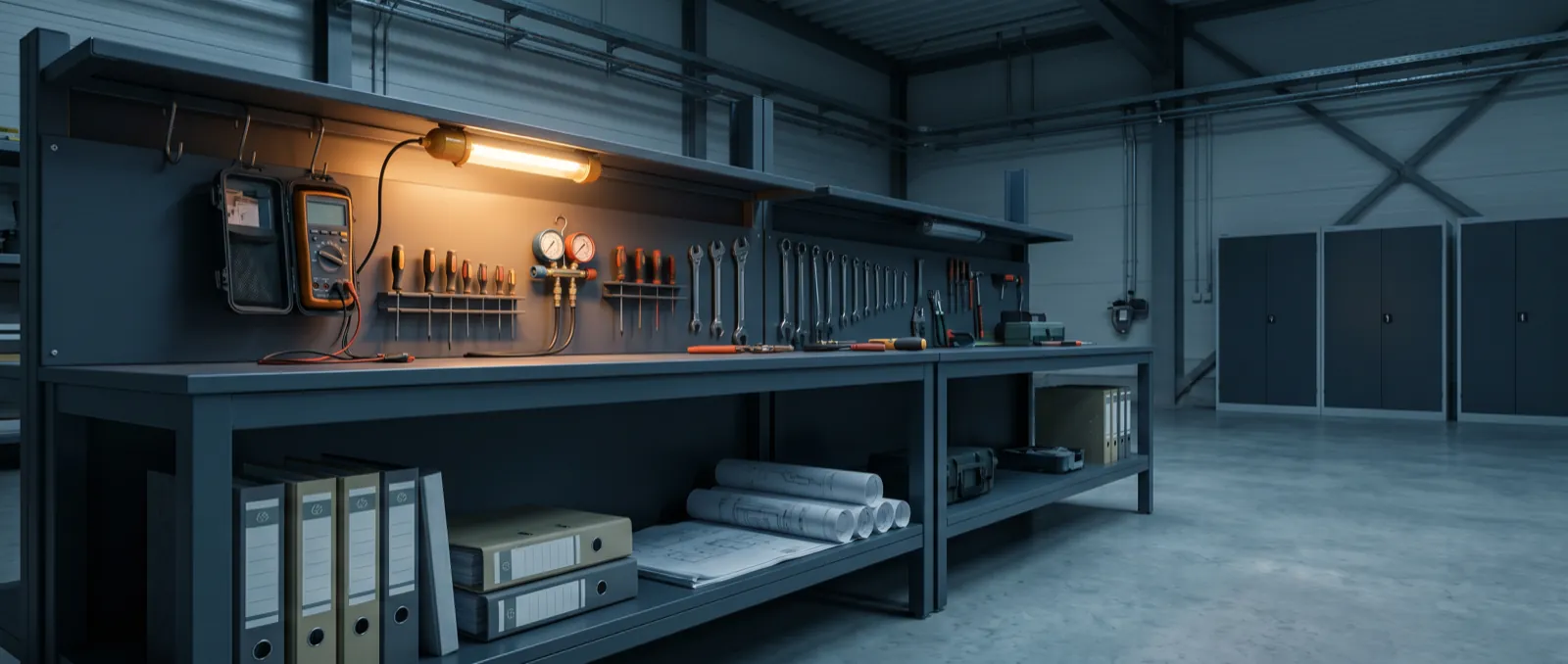
A diagnostic visit takes 2 to 4 hours and returns a written report with three outputs: current efficiency per unit, the cause of any deviation from design, and intervention priority by cost/saving metric. Diagnostics is an assessment, not a service. After it, you know which service is required.
When to book diagnostics rather than a service
A service covers eight standard checkpoints and prepares the unit for the new season. Diagnostics is a different tool for a different problem: when efficiency loss is observed but the cause is unclear.
Book diagnostics in the following cases:
- Gas bill has risen by more than 10 percent over the last two seasons at the same operating regime and a comparable winter.
- The working temperature in the hall takes longer to reach during the morning startup (the morning cycle is longer than it was two years ago).
- A single unit shuts down on the safety thermal cut-out every few days, with no obvious cause.
- The hall has zones consistently 2 to 4 °C colder than the design temperature.
- You have a new owner or facility manager for the building and have no record of previous interventions.
An immediate service would restore the unit to a working state in all these cases, but would not explain why the state is deteriorating.
What is measured on site
The technical engineer arrives with a measurement kit and performs six measurements per unit plus two measurements for the space as a whole.
| Measurement | Instrument | Reference |
|---|---|---|
| Flue-gas composition (O₂, CO, NOₓ, CO₂) | Flue-gas analyser | Factory values for model and gas |
| Flue-gas temperature | Insertion thermometer | Expected range for power |
| Airflow through the exchanger (unit heaters) | Anemometer | Design value (m³/h) |
| Exchanger surface temperature | Non-contact thermometer | Inlet/outlet differential, symmetry |
| Radiant intensity on plaques | Pyrometer + radiometer | Plate output at rated power |
| Fan noise and vibration | Acoustic + vibrometer | Drift from baseline (bearings) |
| Vertical temperature gradient in the hall | Thermometer at multiple heights | 1 to 2 °C/m is normal |
| Thermographic scan of the entire hall | Thermal camera | Heat-loss zones, uninsulated sections |
From these measurements, current efficiency per unit is calculated and compared to design. Thermography flags envelope losses that affect required power but are not an equipment problem.
Three most common silent-failure causes
After ten years of diagnostics on Slovenian installations, three causes cover most cases where efficiency drops without a visible fault.
Cause 1: clogged burner nozzles
Burner nozzles slowly clog with soot and sulfur compounds from the gas. Power drops 5 to 15 percent over 3 to 5 years, with no visible symptoms. Diagnostics detects this in flue-gas temperature and CO/O₂ ratio. Remedy: nozzle cleaning or replacement, 20 to 40 minutes.
Cause 2: drift of the modulating valve
The modulating valve controls the gas/air ratio at variable power. After a few years of operation the setting drifts (temperature, vibration, mechanical wear). The valve works, but at partial power it wastes gas. Diagnostics detects this in the O₂ value at 30 to 60 percent power. Remedy: recalibration, 30 to 60 minutes.
Cause 3: loss of seal between exchanger and flue
On unit heaters, a micro-crack can appear at the exchanger, flue joint after 6 to 10 years. Hot gases partially escape into the space instead of the flue, and cold air enters the exchanger and reduces efficiency. Diagnostics detects this with a differential pressure gauge and a joint-surface inspection. Remedy: gasket replacement or (on older equipment) a full coupling replacement, 60 to 120 minutes.
Visit timeline
| Phase | Duration | Location |
|---|---|---|
| Pre-visit: review of your documentation and the last 24 months of gas bills | 30 min | Office |
| Arrival, walk-through with your maintenance lead, hall review | 20 min | Hall |
| Flue-gas and efficiency measurements on all units | 60 to 120 min | Hall |
| Thermographic scan of the entire hall | 30 to 60 min | Hall |
| Pre-departure briefing of initial findings | 15 min | Hall |
| Post-visit: written report with recommendations | 24 hours | Office |
Total on-site time 2 to 4 hours. A hall over 3000 m² or with more than 8 units requires a full-day visit.
What is in the written report
A written report (PDF) within 24 hours of the visit. It contains:
- Table of measured values for each unit, compared with design and factory references.
- Thermographic map of the hall with highlighted loss zones.
- Diagnosis of causes of deviation from design efficiency, by priority of impact.
- Proposed interventions with cost estimate, expected saving, and payback per item.
- Implementation timing for each intervention (in-season vs. shutdown required).
Diagnostic price: 380 to 680 EUR + VAT for a hall up to 3000 m² and up to 6 units. The price includes the written report. If you order a service intervention after diagnostics, the diagnostic price is deducted from the intervention price.
After diagnostics, technical assistance helps plan the interventions, or you book a maintenance service directly when findings are routine.